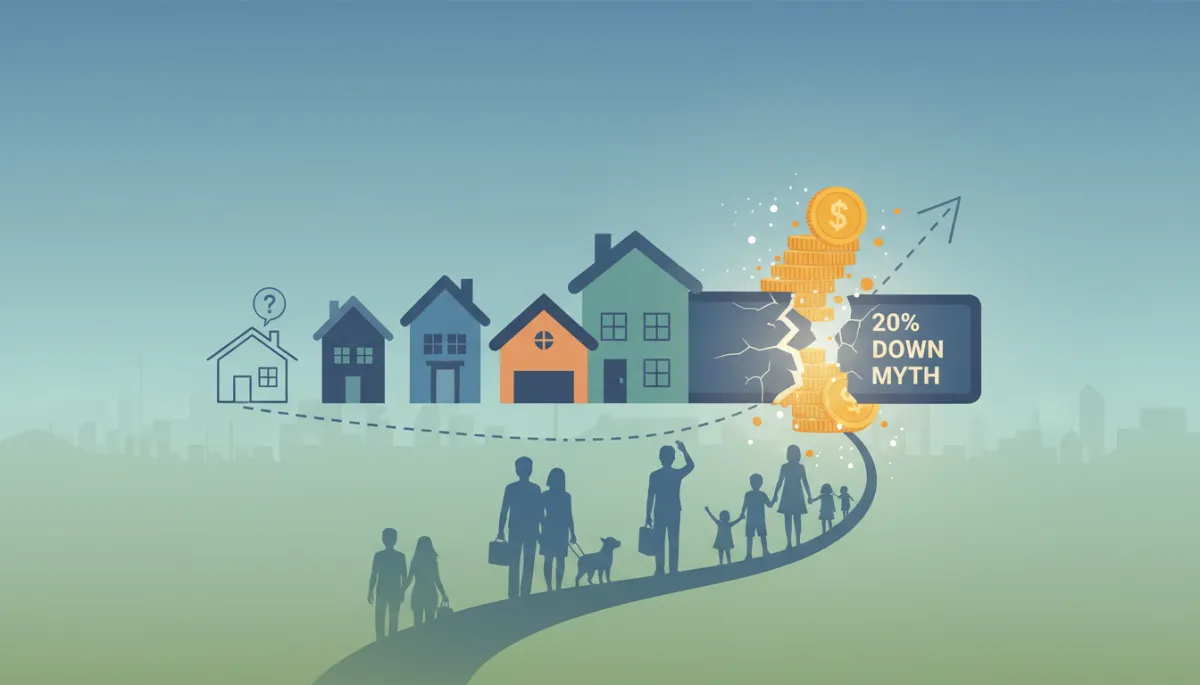
Debunking the 20% Down Payment Myth for Buyers
Real Estate, First-Time Buyers, Mortgage Strategy
The 20% Down Myth Is Killing Your First-Time Buyer Pipeline
If you are still letting buyers walk away to “save up 20%,” you are quietly bleeding future closings. Not because they cannot buy, but because they think they cannot, and no one has bothered to correct the story.
The 20% rule is not a rule. It is a rumor that refuses to die. And it is quietly wrecking your first time home buyer down payment conversations before they even start.
You hear it all the time. “We’ll reach out once we’ve saved 20%.”
Translation: “We’re probably never calling you again.”
The 20% Down Story That’s Costing You Closings
Most buyers picked up this idea from parents, social media, or some random blog from 2012. They think 20% is the price of admission. If they do not have it, they assume they are out. So they stop looking. Stop replying. Or worse. They go find another agent who tells a better story about money.
The truth in 2026 is, there are multiple ways to structure a first time home buyer down payment that have nothing to do with 20%. And if you know how to talk through those options at a high level, you keep more people in your pipeline instead of watching them drift away for “next year.”
The Real Menu: Low Down Payment Mortgage Options That Work
Quick refresher you can use in your buyer consults. You do not need to quote guidelines. Just know the lanes and frame them clearly. Then loop in a lender who can run the numbers and handle the details.
FHA loan down payment. Around 3.5%. For clients with limited savings or less-than-perfect credit, FHA is still a workhorse. With a 580+ score, many can get in around 3.5% down (source: FHA.com). That is a huge difference from 20%. On a $450,000 home, 20% is $90,000. FHA at 3.5% is $15,750. Same house. Very different hurdle.
Conventional loan 3 percent down. A lot of first-time clients hear “conventional” and assume big down payment. Reality. Many qualified first-time buyers can do 3% down on a conventional loan, and plenty of others land in the 3–5% range. Yes, there is mortgage insurance. But that is often cheaper than waiting three more years while prices and rates move around.
VA and USDA. Zero down. VA for eligible veterans, active-duty service members, and some surviving spouses. USDA for qualifying rural and some suburban areas with income limits (source: NerdWallet, FHA.com, USDA program info). Both can offer 0% down for buyers who fit the box. You probably have past clients who qualify and have no idea these exist.
Down Payment Assistance Programs. The Wild Card Your Buyers Ignore
Here is where it gets interesting. Many of your clients actually qualify for down payment assistance programs and never use them. Grants. Forgivable seconds. Zero-interest loans that sit quietly until the home is sold or refinanced. Programs funded by states, cities, housing agencies, and bond programs across the country (see examples from MetroDPA in Colorado, My Choice Texas Home, and others in 2026 data).
The details change by state and county. The big idea does not. Your client’s “we only have $8,000” might actually be plenty when paired with a low down payment mortgage and the right assistance layer. They do not know that. You do. Or you can – with the right lending partner who lives in this stuff every day.
💡 Pro Tip: Keep a one-page cheat sheet of your local down payment assistance programs in your listing and buyer folders. You do not need to sell the program. Just show that help exists and tag in your lender.
How To Use This In Listing Appointments And Buyer Consults
This is not just buyer-side talk. This is listing leverage too.
Listing appointments. Sellers worry there are “no first-time buyers out there” because rates are higher and prices feel sticky. You can confidently say. “Actually, there are a lot of qualified buyers who think they need 20% down. Our strategy is to partner with a lender who educates them on FHA at 3.5%, conventional at 3–5%, VA/USDA at 0%, plus assistance programs. That opens your buyer pool.” You are not just listing a house. You are bringing a system to create more qualified buyers for it.
Buyer consultations. Early in the meeting, ask. “What have you heard about how much you need for a down payment?” Let them talk. Then reset. “There are real options at 0%, 3%, 3.5%, and 5%. The next step is not saving for five more years. It is a quick call with my lender to see which bucket you fall into.” Simple. Clear. Actionable. And it keeps them with you instead of ghosting.
Why Partner With A “No Suits. Not a Bank.” Lender For This
This only works if your lending partner can actually deliver all these paths. At Dwell Mortgage, we work with 40+ investors and offer conventional, FHA, VA, USDA, jumbo, renovation, construction, bridge, HELOC, DSCR, foreign national, bank statement, no tax return, and a deep bench of down payment assistance programs in the states we serve.
Translation for you: When you send us a hesitant first-time client, we are not trying to shove them into one product. We are looking at the full picture. Credit. Income. Savings. Geography. Then matching them with the right first time home buyer down payment structure so your deal can actually happen.
Stop Losing Deals To A Myth
You work too hard to let an outdated 20% story kill your first-time buyer pipeline. The tools are there. FHA at 3.5%. Conventional at 3–5%. VA and USDA at zero down for the right clients. A long list of down payment assistance programs that can bridge the gap between “we only have a few thousand” and “we own a home.”
Next time a client says “we’ll circle back when we have 20%,” do something different. Pause. Tell them there are real first time home buyer down payment options that start at 0% and 3%. Then loop us in before you write them off.
You can connect with a Dwell pro and tag us into the conversation. No suits. Not a bank. Just a partner who cares about getting your clients home and your deals closed.
Quick FAQ For Your Next Buyer Conversation
Do first-time buyers really need 20% down to buy?
No. Many can buy with 0–5% down using FHA, conventional, VA, USDA, or down payment assistance layered with those loans. 20% is optional, not required.
Is a low down payment mortgage always more expensive?
Monthly payments can be higher because of mortgage insurance or a slightly higher rate. For many clients, buying sooner and starting equity growth is worth more than waiting years to hit 20%.
How should I explain down payment assistance without overpromising?
Keep it simple. Tell clients “there are programs that can help with part of your down payment and closing costs, depending on income, location, and credit. Let’s have my lender check what you qualify for.”
